
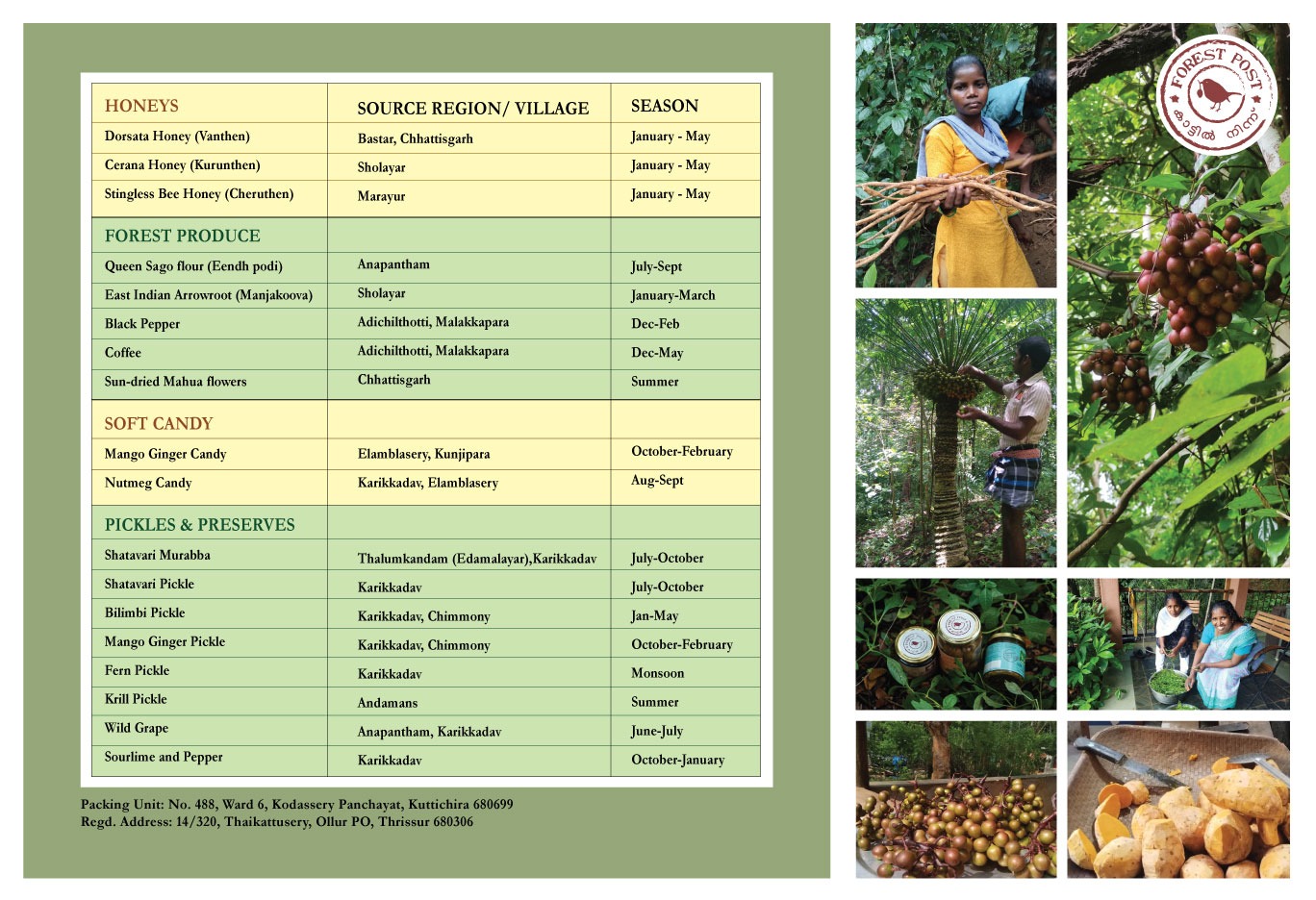
This season chart we developed last year is a glimpse of seasonal food produce that are value-added in the different women’s groups we work with. You can see why so many of our food products are so often out of stock – it is because they have a narrow harvest season; and since we do not use any preservatives apart from unrefined sugar, sesame oil and coconut vinegar, the shelf life is also rather narrow.
In addition to the ones listed in this chart, there are a range of foraged foods that are part of the diet of Kadar, Malayar and Muthuva communities in the landscape – for example, tubers, queen sago, palm sago (albeit rarely harvested and processed) and fish and crabs. During our engagement in every village, we try to tap into food memories that are sometimes fresh in people’s minds, despite a change in their diet. Deeply ingrained in the foraging way of uncertainty of harvest. Acknowledging that has helped us understand the philosophy.
While foods like Queen Sago have taken a fair amount of incentivisation from our end, since the process is labour intensive, it always felt good when harvest for value-addition became an excuse to bring back some of these forgotten foods in their diet. The element of forest-dependency has largely reduced in most of these communities, particularly in relation to food. Except perhaps among the Kadar and few remote Malayar and Muthuva villages where the harvest of a rare wild edible is not for sustenance, but more for the joy of sharing the memory of a taste with the younger generation.
Wonderful initiative 👏 and products.